
How can I ask for help if I can no longer keep up caregiving?
A quick route past safety, the GP, the local office, and respite care in Zoetermeer.
Read article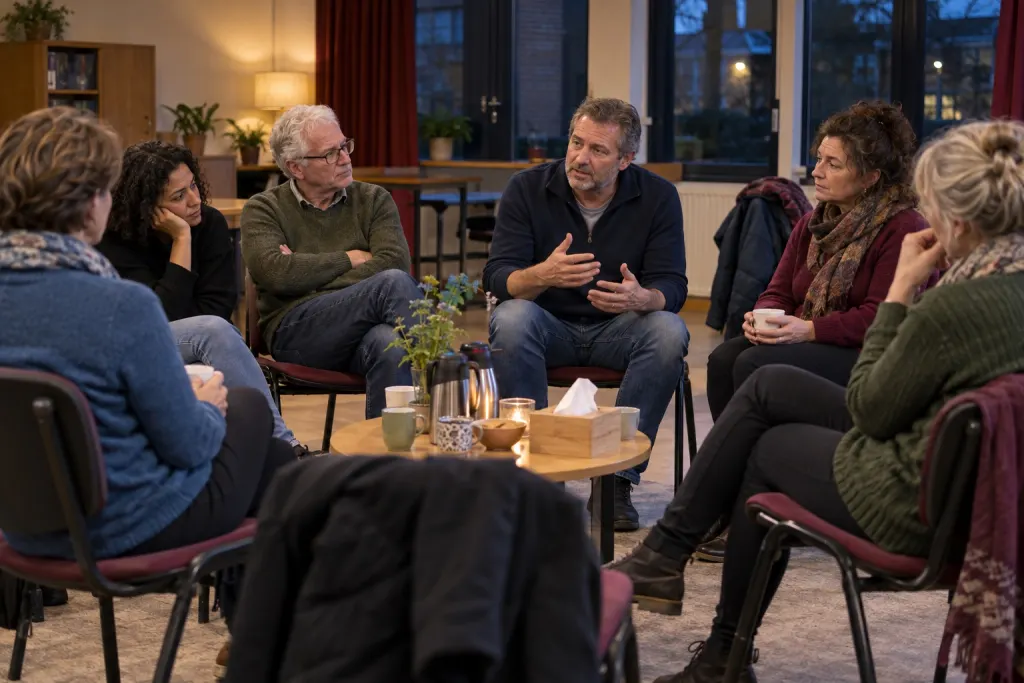
What peer support can offer and which places in Zoetermeer you can choose from.
Peer support can help if you are carrying a lot on your own. You talk with people who understand what informal caregiving feels like in everyday life. That can bring relief and also practical ideas.
Peer support provides recognition. You hear from people who also combine caring, organizing, and carrying on. That can help you share experiences and gain practical ideas.
For dementia, you can go to an Alzheimer Café or Trefpunt. There you can ask questions and get information from experts. Participation is free, but location and date may vary. Peer support does not replace professional care, but it can provide support.
In Zoetermeer there are informal caregiver cafés, neighborhood meetings, and discussion groups. In the informal caregiver café, themes are discussed and experiences are shared. In neighborhood meetings and discussion groups, you can talk with other informal caregivers.
For informal caregivers dealing with dementia, there are discussion groups at inZet. These are tailored to the stage of the dementia. There is also a partner discussion group. In addition, there is an informal caregiver café every month, where you meet other informal caregivers.
For current meetings, you can look at an informal caregiver café or a current activity for informal caregivers in Zoetermeer. Theme, date, and location often change. A current overview shows what is available now.
Through Zoetermeerwijzer you can search for local offerings. There you will find advice, practical help, respite care, activities, and organizations. If you cannot find anything that fits, you can ask an informal care coordinator for a new date or an individual appointment.
You do not have to share anything personal right away. Listening is fine too. You may also ask a practical question.
At a first meeting, you can share experiences, ask questions, and receive information. In a group, there is room for recognition and ideas from others. For dementia, you will hear through the local access point when the next group starts and how to register.
If an in-person meeting does not suit you, online peer support can be an alternative. If you would rather talk one-on-one, an informal care coordinator may be a better fit. In a personal conversation, there is room for your private situation, boundaries, and organizational tasks.
A group is useful if you want to exchange experiences. Individual support is more suitable if you want to discuss something personal. Both forms can exist alongside each other.
First, look at what kind of contact you are seeking. Do you want someone to think along with you, a group, or contact with other informal caregivers? After that, you can view the local options via Zoetermeerwijzer.
Discuss your choice with an informal care coordinator if you want help choosing. You can also ask for independent client support. That makes it easier to find a form that suits you now.
A quick route past safety, the GP, the local office, and respite care in Zoetermeer.
Read article
Why setting boundaries helps, how to make choices, and when talking can provide support.
Read articleA plan for signs of overload, safety, and support in caregiving that has gone off track.
Read article
Caring for someone can raise many questions. Whether it's practical questions, doubts, sharing your worries or simply wanting to tell your story.
Sophie listens and thinks along with you – with understanding for your situation.